Floor Preparation in Dubai — Subfloor, Levelling, Waterproofing & Moisture Testing Before Tile, Wood, Epoxy or Vinyl Installation
In This Guide
1. Why Floor Preparation Fails in Dubai — Heat, Moisture & Hollow Tiles
2. The 5 Steps of Subfloor Preparation
3. Moisture Testing — The Skipped Step That Kills Floors
4. Floor Levelling — Self-Levelling Compound & Screed
5. Waterproofing Membrane for Dubai Bathrooms & Wet Areas
6. Preparation Requirements by Floor Type
7. Floor Preparation Cost Guide Dubai
8. Questions to Ask Your Flooring Contractor
9. Frequently Asked Questions
1. Why Floor Preparation Fails in Dubai — Heat, Moisture & Hollow Tiles
Subfloor preparation in Dubai is the number one reason flooring installations fail. The Dubai climate, hot concrete slabs, hard water, rising damp in ground-floor apartments, and the temperature shock between air conditioning and outdoor heat all attack flooring through the substrate beneath. Hollow tiles, unprimed concrete, uneven floors, untested moisture levels, and missing waterproofing membranes cause more flooring problems in Dubai than any other factor.
Cheap flooring contractors in Dubai skip preparation to cut prices. The result is cracked porcelain tiles, blistering epoxy floors, warped parquet wood, lifting laminate, debonded marble, hollow SPC vinyl, and bathroom water leaks into the apartment below. Every step in this guide — floor demolition, substrate grinding, moisture testing, self-levelling compound, primer, waterproofing — exists for a reason.
Find flooring contractors in Dubai who prepare correctly on Taamir →
2. The 5 Steps of Subfloor Preparation
Every flooring installation in Dubai — tile, marble, wood, vinyl, epoxy, micro cement, laminate, carpet — follows the same 5-step preparation sequence.
Step 1 — Floor Demolition or Overlay Assessment
Remove old tiles, old vinyl, old laminate, or old wood flooring carefully. Tap-test existing tiles for hollow spots — a hollow sound means the tile has debonded and must be removed. SPC vinyl, micro cement, and some large-format porcelain tiles can be installed over sound existing tiles without demolition. Hollow tiles always need removal.
Step 2 — Substrate Assessment & Repair
After demolition, inspect the concrete substrate for cracks, hollow screed, surface contamination, oil, paint residue, old tile adhesive, and laitance — the weak powdery layer on Dubai concrete surfaces. Use diamond grinding or shot-blasting to remove laitance and contamination. Fill structural cracks with epoxy crack filler. Inject grout into hollow screed areas. Replace damaged screed sections.
Step 3 — Moisture Testing
Test moisture in the concrete slab before any flooring installation. Plastic sheet test, calcium chloride test, or relative humidity probe — the three methods used in Dubai. Epoxy floors and engineered wood floors fail if moisture is above 75% RH. Skip this step and the floor will blister, lift, or warp within months.
Step 4 — Floor Levelling
Self-levelling compound for height differences up to 10mm. Sand-cement screed for larger height corrections — minimum 28-day curing time before installing wood, vinyl, epoxy, or micro cement above. Flatness tolerance for porcelain tile installation: 3mm in 2 metres for standard tiles, 2mm for large-format tiles. Wide-plank wood flooring and SPC vinyl flooring also require 2-3mm flatness.
Step 5 — Primer & Adhesive Preparation
Apply the correct primer for the floor type — PVA primer for tile, epoxy primer for epoxy floors, micro cement adhesion primer for micro cement. Primer seals the concrete substrate, strengthens the surface, prevents premature adhesive drying in Dubai's heat, and creates the chemical bond between substrate and floor covering.
Find flooring contractors in Dubai for tile, wood, vinyl, epoxy and more on Taamir →
3. Moisture Testing — The Skipped Step That Kills Floors
Concrete moisture testing is the most skipped step in Dubai flooring projects and the cause of most epoxy floor failure, wood floor warping, and adhesive failure under porcelain tiles. Dubai ground-floor apartments, podium-level slabs, and new-build concrete all carry construction moisture and rising damp. The temperature gradient between Dubai's air-conditioned interior and hot concrete slab drives moisture upward into the floor adhesive.
Moisture Test Methods Used in Dubai
• Plastic sheet test — Tape clear plastic to the concrete for 24 hours. Condensation underneath means moisture is present. Pass/fail screening test only.
• Calcium chloride test — Quantitative moisture vapour emission rate test. Used by professional flooring contractors in Dubai before epoxy and wood installation.
• Relative humidity probe — The most accurate concrete moisture test. Probe inserted into a drilled hole measures internal slab humidity. Industry standard for commercial projects and premium residential.
Acceptable Moisture Levels for Dubai Floors
• Porcelain tile and ceramic tile — Up to 75% RH with standard tile adhesive. Above 75% needs moisture-tolerant adhesive or damp proof membrane (DPM).
• Epoxy flooring — Maximum 75% RH. Above this causes osmotic blistering, the most common epoxy floor failure in Dubai.
• Engineered wood and parquet wood flooring — Maximum 65-75% RH depending on manufacturer.
• SPC vinyl flooring — Up to 75-80% RH with vapour barrier underlay.
• Micro cement — Substrate must be fully dry. Highly sensitive to moisture.
Find moisture-conscious tile installation professionals in Dubai on Taamir →
4. Floor Levelling — Self-Levelling Compound & Screed
Floor levelling is essential for large-format porcelain tile installation, marble flooring, engineered wood, parquet wood flooring, SPC vinyl, epoxy floors, and micro cement. Dubai concrete floors are rarely flat enough for modern flooring without levelling work. Uneven floors cause cracked tiles, hollow planks, rocking marble slabs, drum-like vinyl sounds underfoot, and visible humps in epoxy and micro cement surfaces.
Self-Levelling Compound for Dubai Floors
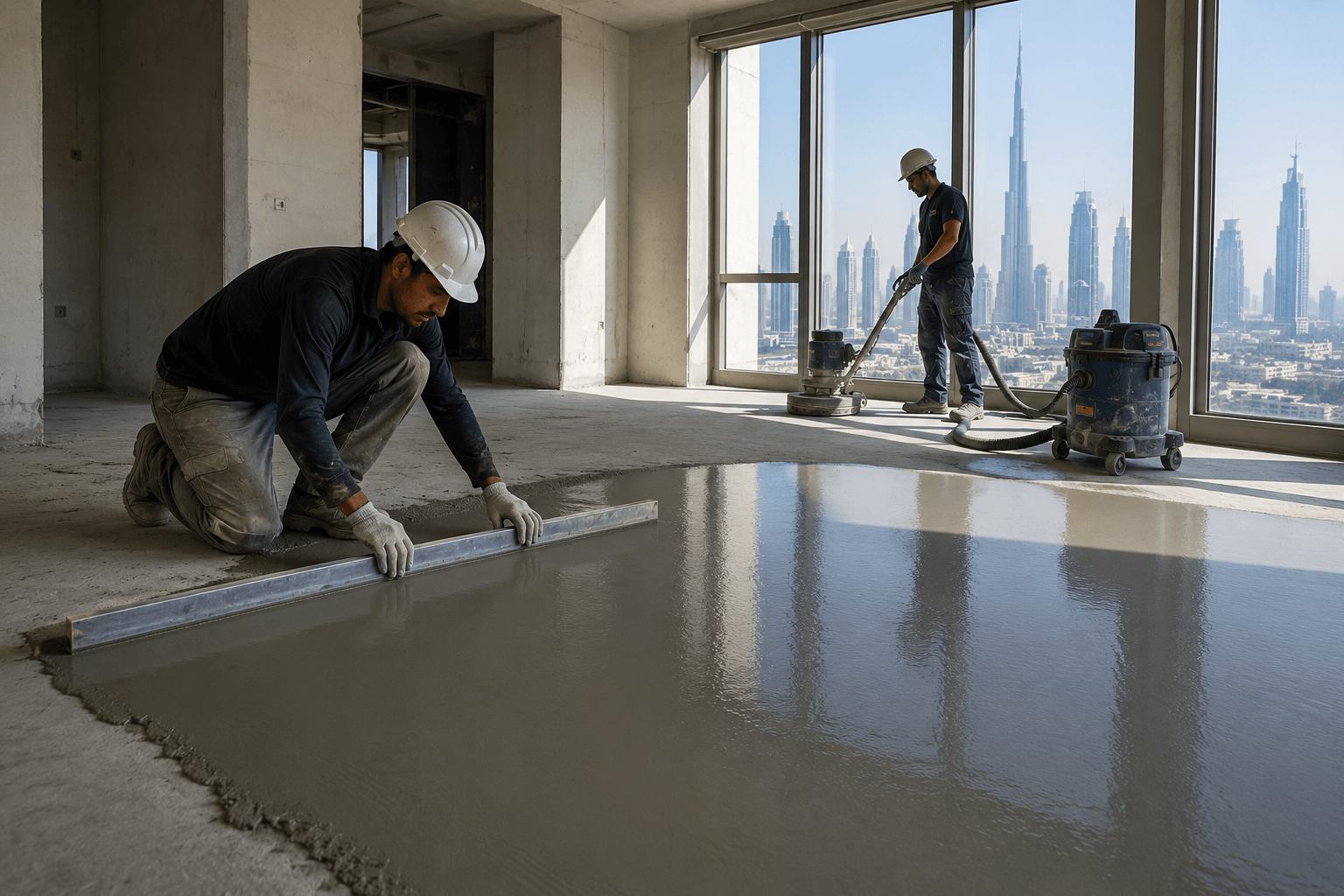
Polymer-modified cement floor levelling compound poured onto the substrate. Flows under gravity, fills depressions, cures in 24-48 hours, achieves tight flatness tolerance. Used for height differences up to 10-15mm. Standard for SPC vinyl flooring, engineered wood flooring, and large-format tile preparation in Dubai apartments.
Sand-Cement Screed for Larger Levelling Work
For height corrections above 15mm — new screed laid and floated by hand to a flat surface. Required for full bathroom renovations, kitchen floor renovations, and villa flooring projects with significant height variation. Minimum 28-day curing time before wood, vinyl, epoxy, or micro cement installation. Compressing this curing time is responsible for many Dubai flooring failures — fresh screed releases moisture into the floor above for weeks after laying.
Find flooring contractors who level floors correctly in Dubai on Taamir →
5. Waterproofing Membrane for Dubai Bathrooms & Wet Areas
Waterproofing membrane is mandatory for every Dubai bathroom, wet room, walk-in shower, kitchen with apartment below, laundry room, utility area, and rooftop terrace. Skipping the waterproofing membrane causes bathroom leaks, water damage to the apartment below, mould in walls, and legal liability for the property owner.
Waterproofing Membrane Types
• Liquid-applied waterproofing membrane — Polymer-modified cement or bitumen emulsion brushed in coats. Standard for Dubai bathroom waterproofing. Fast application, easy detailing around pipes.
• Sheet waterproofing membrane — Pre-formed bituminous or thermoplastic sheets. Used for wet rooms, large bathrooms, and rooftop terrace waterproofing.
• Cementitious crystalline waterproofing — Reacts with moisture to block concrete pores. Used in ground-floor slabs and below-grade applications.
Where Bathroom Waterproofing Fails
Most Dubai bathroom waterproofing failures are not the membrane material — they are wall-floor junctions, pipe penetrations, and drain flanges where the membrane is incomplete. Use reinforcing mesh tape at junctions, proprietary collars at pipes, and integrated drain flanges. Inspect the waterproofing membrane before tiles are laid — once tiled, you cannot verify the work without removing the tiles.
Find tile installation and waterproofing contractors in Dubai on Taamir →
6. Preparation Requirements by Floor Type
Porcelain Tile & Ceramic Tile Installation Preparation
Flatness: 3mm in 2m for standard tiles, 2mm for large-format tiles 60x120cm and above. Moisture: under 75% RH. Substrate ground to remove laitance. Flexible tile adhesive matched to tile size. Epoxy grout for wet areas. Full-bed adhesive application — no spot-fixing for large tiles.
Find tile flooring contractors in Dubai on Taamir →
Marble Flooring & Natural Stone Preparation
Stricter flatness — 2mm in 2m. White flexible adhesive for translucent marble (Calacatta, Carrara, Crema Marfil). Full-bed adhesive only — every point of the stone must be supported. Waterproofing membrane under all bathroom marble. Epoxy grout. Penetrating stone sealer applied before grouting.
Find marble flooring contractors in Dubai on Taamir →
Parquet Wood Flooring & Engineered Wood Preparation
Flatness 2mm in 2m. Moisture under 65-75% RH. New screed cured minimum 28 days. Wood acclimatised in installation room 48-72 hours before laying. Vapour barrier underlay for floating wood installation. Never install wood flooring in Dubai bathrooms.
Find parquet and wood flooring contractors in Dubai on Taamir →
SPC Vinyl Flooring Preparation
Flatness 3mm in 2m. Remove all old adhesive ridges. SPC vinyl can install over sound existing tiles in Dubai apartments — tap-test first. Vapour barrier underlay for concrete substrates. Highest moisture tolerance of any hard floor in Dubai.
Find SPC vinyl flooring contractors in Dubai on Taamir →
Epoxy Flooring Preparation
Shot-blasting or diamond grinding is mandatory for epoxy floor adhesion. Fill all cracks with epoxy crack filler. Moisture test essential — substrate must be under 75% RH or epoxy will blister. Apply matching epoxy primer before body coat. Anti-slip aggregate for bathroom epoxy and kitchen epoxy floors.
Find epoxy flooring contractors in Dubai on Taamir →
Micro Cement Flooring Preparation
Existing tiles must be sound — hollow tiles cause micro cement delamination. Specialist micro cement adhesion primer in 2 coats. Fibreglass mesh embedded at junctions and stress points. 4-6 coats of polyurethane sealer in wet rooms after micro cement application. Annual sealant refresh in Dubai bathrooms.
Find micro cement flooring contractors in Dubai on Taamir →
Laminate Flooring Preparation
Flatness 3mm in 2m. Vapour barrier underlay essential on Dubai concrete substrates. Never install laminate in bathrooms, kitchens, or any wet area in Dubai — HDF core swells with moisture.
Find laminate flooring contractors in Dubai on Taamir →
Carpet Flooring Preparation
Level substrate free of sharp protrusions. Tackless strip secured to concrete. Quality underlay across entire floor. Moisture-controlled substrate to prevent mould in carpet backing.
Find carpet flooring contractors in Dubai on Taamir →
7. Floor Preparation Cost Guide Dubai (2025)
Floor Demolition & Removal Costs Dubai
• Porcelain tile and ceramic tile removal: AED 20-40 per sqm.
• Engineered wood or laminate flooring removal: AED 10-25 per sqm.
• Carpet and underlay removal: AED 8-15 per sqm.
• Debris disposal in Dubai: AED 5-15 per sqm.
Substrate Preparation Costs Dubai
• Diamond grinding or shot-blasting: AED 15-35 per sqm.
• Epoxy crack filling: AED 50-150 per linear metre.
• Hollow screed grout injection: AED 200-500 per sqm of hollow area.
• Screed replacement: AED 60-120 per sqm.
Moisture & Waterproofing Costs Dubai
• Concrete moisture test (CaCl or RH probe): AED 200-500 per test.
• Damp proof membrane epoxy coating: AED 50-100 per sqm.
• Bathroom waterproofing membrane: AED 40-80 per sqm.
• Wet room or rooftop sheet membrane: AED 80-150 per sqm.
Floor Levelling Costs Dubai
• Self-levelling compound up to 5mm: AED 30-60 per sqm.
• Self-levelling compound 5-10mm: AED 50-90 per sqm.
• New sand-cement screed 40-60mm: AED 60-120 per sqm.
Typical Dubai apartment bathroom full preparation — demolition, substrate repair, moisture test, waterproofing membrane, levelling — adds AED 3,000-7,000 to a flooring project before tiles are purchased. This is not avoidable cost — it is the foundation cost.
Find Dubai flooring contractors who price preparation transparently on Taamir →
8. Questions to Ask Your Flooring Contractor
• Will you tap-test the existing floor for hollow tiles before quoting?
• Will you grind or shot-blast the concrete substrate to remove laitance?
• Will you perform a concrete moisture test before installation?
• What flatness tolerance does my flooring require and how will you achieve it?
• Which self-levelling compound or screed will you use?
• If new screed is needed, will you wait 28 days before installing my flooring?
• Which primer will you use on the concrete substrate?
• Which tile adhesive will you use and is it flexible and rated for Dubai conditions?
• Will you use epoxy grout in wet areas?
• Which waterproofing membrane will you apply in bathrooms and how will you detail junctions?
• Can I inspect the waterproofing membrane before tiles are laid?
A professional flooring contractor in Dubai answers these questions clearly. A contractor who deflects or cannot answer is telling you about the quality of work to expect.
Find flooring contractors in Dubai who answer these questions on Taamir →
9. Frequently Asked Questions
Do I need to remove old tiles before installing new flooring in Dubai?
Not always. SPC vinyl flooring, micro cement, and some large-format porcelain tiles can be installed over sound existing tiles in Dubai apartments. Hollow tiles must be removed. A flooring contractor will tap-test the existing floor before recommending overlay or full tile demolition.
How do I test my Dubai concrete floor for moisture before flooring installation?
Tape clear plastic film to the concrete for 24 hours — condensation underneath shows moisture. For accurate readings, use a calcium chloride test or relative humidity probe — services offered by professional flooring contractors in Dubai for AED 200-500 per test.
Why did my epoxy floor blister after installation in Dubai?
Osmotic blistering of epoxy floors in Dubai is caused by moisture in the concrete substrate — the moisture was not tested before installation. The only fix is full epoxy removal, substrate moisture mitigation, re-grinding, and re-coating with moisture-tolerant primer.
How long does floor preparation take in a Dubai apartment?
A 100 sqm Dubai apartment receiving new porcelain tiles takes 4-6 working days for full preparation: tile removal (1-2 days), substrate grinding (1 day), levelling and curing (1-2 days), waterproofing in bathrooms (1 day plus curing). Contractors promising full apartment tiling including preparation in 3 days are skipping steps.
Can I skip bathroom waterproofing to save money?
No. A Dubai apartment bathroom without waterproofing membrane will leak water into the apartment below. The property owner is liable for the damage. Waterproofing membrane costs AED 40-80 per sqm — negligible against the cost of water damage liability.
What is the difference between self-levelling compound and screed?
Self-levelling compound is a pourable polymer-modified cement product for height differences up to 15mm. Cures in 24-48 hours. Sand-cement screed is hand-laid for height differences above 15mm. Requires minimum 28-day curing time before wood, vinyl, epoxy, or micro cement installation.
How do I find a flooring contractor in Dubai who does preparation properly?
On Taamir you can find and compare flooring contractors in Dubai — tile, marble, wood, parquet, SPC vinyl, epoxy, micro cement, laminate, and carpet specialists. Browse their profiles and see previous projects before making a decision.
Find and compare flooring contractors in Dubai on Taamir →
Find Flooring Contractors in Dubai Who Prepare Correctly
On Taamir you can find and compare flooring contractors in Dubai for tile installation, marble flooring, parquet wood flooring, SPC vinyl flooring, epoxy floors, micro cement, laminate, and carpet. Browse profiles and see previous projects.
Marble & Stone Flooring Dubai →
Parquet & Wood Flooring Dubai →